



A report from British Columbia’s ombudsperson found key gaps remain in legal safeguards for patients receiving involuntary care.
Ombudsperson Jay Chalke said his office is “deeply concerned” that health-care staff are involuntarily admitting and treating a significant number of patients without completing required forms.
The report, released Monday, is the latest followup on the province’s progress in implementing 24 recommendations made in 2017. It examines data from July to September 2024.
While the report noted improvements in recent years, it found several health authorities are still failing to include all required forms in more than 50 per cent of patient files.
“I recognize the health-care system is under strain,” Chalke said in a statement. “However, the required safeguards are not simply administrative paperwork. They are the legal protections that help ensure decisions to admit and treat someone are lawful, accountable and rights-respecting. They must be completed 100 per cent of the time, in each and every case.”
The Provincial Health Services Authority reported the highest completion rate, at more than 90 per cent. Regional health authorities varied widely, with Vancouver Coastal Health reporting the highest rate at 81 per cent, while Northern Health had the lowest at 34 per cent.
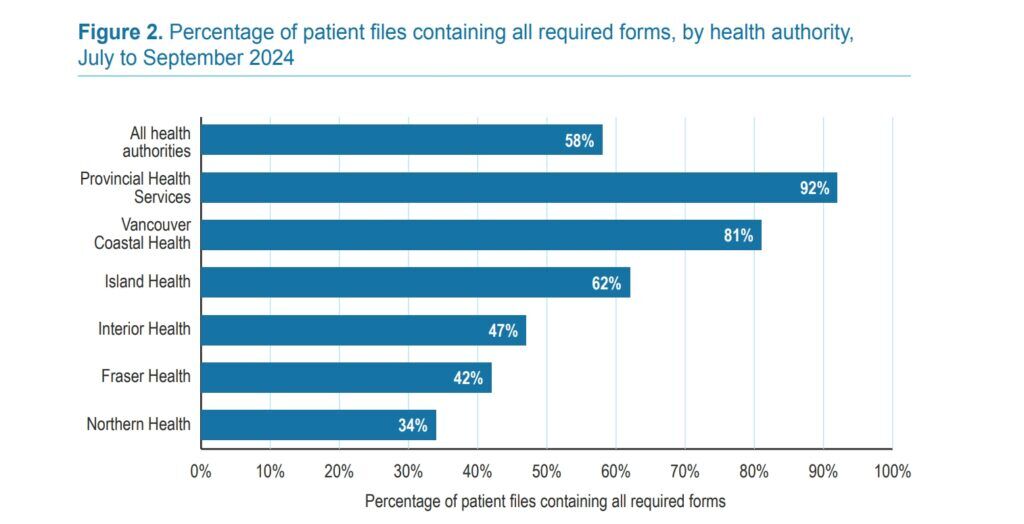
The report said it is particularly concerning that the legally required Form 5 is not always completed. The form confirms involuntary treatment has been properly authorized. Across all health authorities during the three-month period, Form 5 was completed 87 per cent of the time.
The report noted the form is especially important since the B.C. government repealed the deemed consent provision of the Mental Health Act in December.
It also found that while an Independent Rights Advice Service is available to involuntary care patients in B.C., it is generally not provided unless a patient requests it.
“Independent rights advice is one of the most important safeguards for involuntary patients,” Chalke said. “But it can’t depend on whether someone knows to ask for it, or whether busy hospital staff have time to connect them. It needs to be built in, so people get timely, independent support when they need it most.”
Chalke said the province has fully implemented half of the 24 recommendations from the 2017 report and has made progress on eight others.
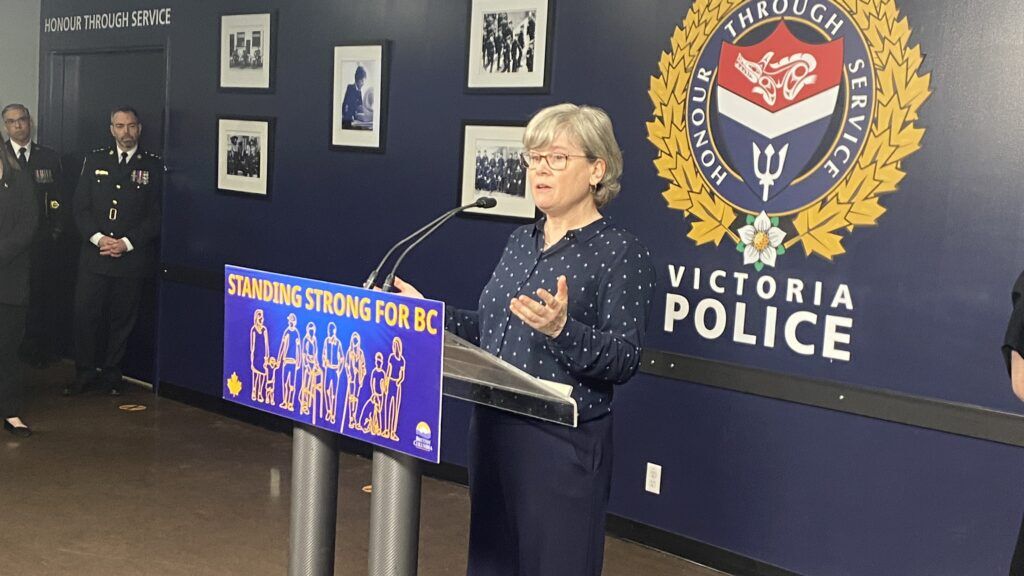
“We have made enormous progress since the ombudsperson’s report first came out back in 2017,” Health Minister Josie Osborne said at an unrelated event in Victoria on Monday.
“There’s always more work to do, and I have directed health authorities to ensure they are doing everything possible to make sure forms are filled out completely, accurately and in a timely manner,” she said.
Nicole Luongo, an analyst with the Canadian Drug Policy Coalition, said patients being admitted without proper documentation is “extraordinarily serious.”
“Even if all of the proper documentation was taking place 100 per cent of the time, that alone I don’t think would address the crux of the issue, which is that involuntary detention is still over-deployed,” Luongo said. “It’s not a substitute for implementing the resources that would prevent detention to begin with.”
Luongo said the coalition is not opposed to involuntary detention in all cases, but believes it should be limited to exceptional circumstances.
“And right now, that is not how it’s deployed at all,” she said.
Provincial data included in the report showed more than 15,500 people were involuntarily hospitalized under the Mental Health Act in the 2024-25 fiscal year. Some patients were admitted more than once, bringing the total number of involuntary hospitalizations to 21,380.
The number of involuntary hospitalizations has declined steadily since peaking at nearly 25,300 in the 2021-22 fiscal year.
The post B.C. ombudsperson says required paperwork too often missing for involuntary care patients appeared first on AM 1150.
Something going on in the Prince George area you think people should know about?
Send us a news tip by emailing pgnews@vistaradio.ca.