

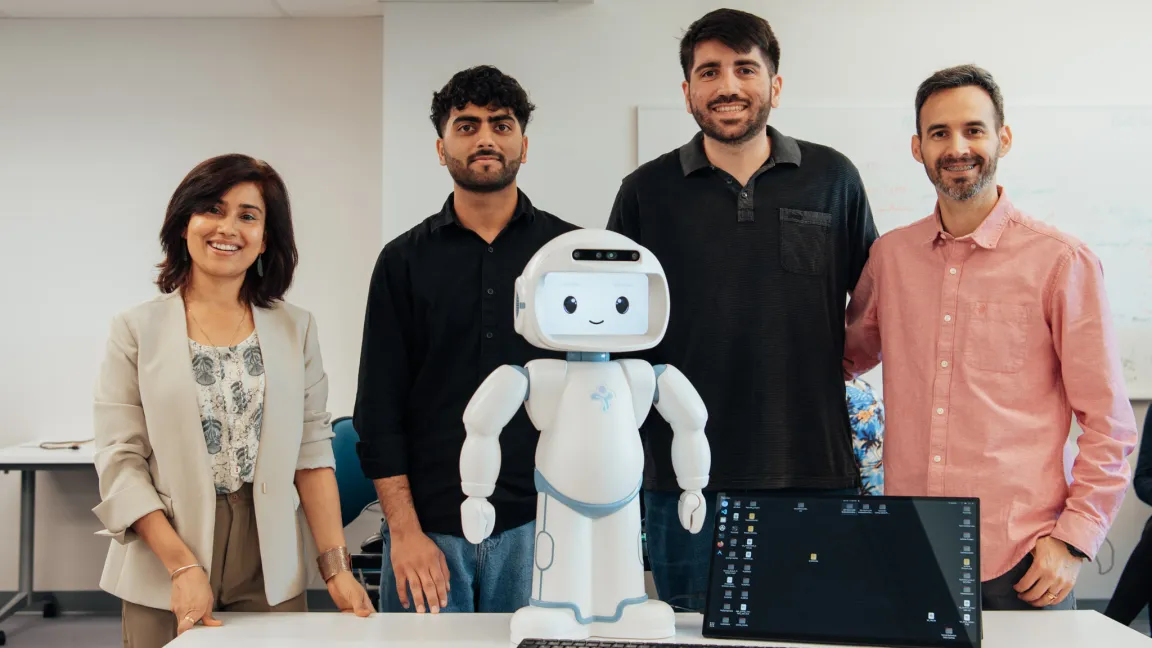

A UNBC Computer Science Assistant Professor recently led a project looking at how children interact with robots in real, everyday learning environments.
Last summer, a the unit called QTrobot became part of a children’s learning environment as well as the centerpiece of a research study.
A group of researchers led by Dr. Shruti Chandra monitored the interactions in the background.
“Children behave differently outside the lab, and technologies that perform well under controlled conditions may not translate effectively into everyday use,” she explained.
Dr. Chandra published the results of her research at the 21st Association for Computing Machinery/Institute of Electrical and Electronics Engineers International Conference on Human-Robot Interaction in a paper titled Social robots on the loose: Supporting children’s independent learning in the wild along with five student co-authors.
To conduct the experiment, Dr. Chandra worked with the UNBC Active Minds summer camp team to integrate the social robots into camp programming.
“Summer camps provide a wonderful opportunity to test and validate these systems because children from diverse backgrounds attend, they use the system for several days and provide feedback to improve it,” Dr. Chandra says. “We designed the robot system in a way that can be deployed in summer camp classrooms in the wild without any technical or adult supervision, so it was a perfect venue for us to technically evaluate these systems and study children’s perspectives.”
The study ran over two months across seven summer camps, each lasting three to five days.
Roughly 150 children aged six to 12 interacted with a humanoid robot through ten game-based learning activities tailored to their developmental stages.
The research showed noted autonomous social robots can be integrated into classroom settings and are generally well accepted by children, while also revealing age-specific differences in engagement and perception.
Building on the success of last summer’s field study, Dr. Chandra and her team are returning this summer to investigate how tangible, embodied interactions with social robots can create more engaging learning experiences for children.
Something going on in the Prince George area you think people should know about?
Send us a news tip by emailing pgnews@vistaradio.ca.